Can the 2026 Mazda CX-90 PHEV Cover Your Daily Commute on Battery Alone?
June 11 2026,
A plug-in hybrid makes the most sense when you understand what it's actually doing. The 2026 Mazda CX-90 PHEV is a three-row SUV that runs on battery power for daily urban distances — up to 43 km per charge — and switches to a gasoline engine when the battery runs out. For drivers whose commutes stay within that range and who can charge overnight, the math on fuel costs shifts significantly compared to a conventional vehicle.
This article breaks down how the CX-90 PHEV operates during a typical weekday commute: how the powertrain manages the battery, what the charging routine actually looks like, and where the fuel savings show up in practice.
The Powertrain: How It Works Day to Day
The CX-90 PHEV pairs a 2.5 L naturally aspirated four-cylinder engine with an electric motor and a 17.8 kWh lithium-ion battery. The combined system output is 323 horsepower and 369 lb-ft of torque with premium 91-octane fuel. On a fully charged battery, the car prioritizes electric power — the gasoline engine stays off unless the battery depletes, demand exceeds what the motor can deliver, or the driver activates it manually.
EV Mode in the Mi-Drive system forces electric-only operation for as long as the battery allows. Normal mode manages the transition automatically — drawing from both sources and prioritizing efficiency without requiring the driver to make powertrain decisions in traffic.
NRCan rates the CX-90 PHEV at 4.2 Le/100 km blended — a figure that assumes a regular mix of charged electric kilometres and gasoline kilometres under standard test conditions. For drivers whose daily round-trip commute sits under 43 km, a full overnight charge can cover the whole trip on electricity alone. The gasoline engine simply doesn't run on those days.
Charging on a Typical Night
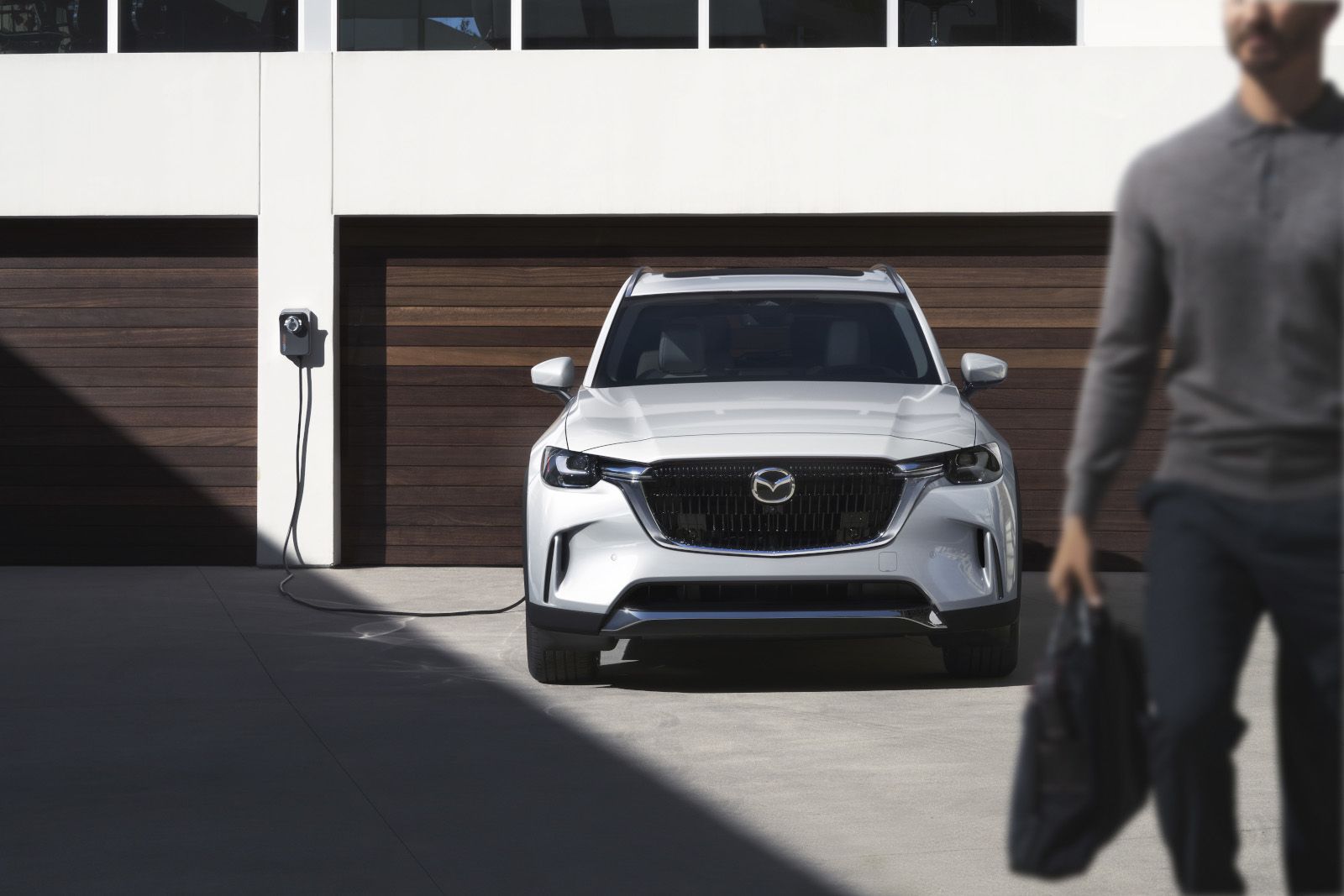
Charging the CX-90 PHEV doesn't require any special setup to be practical. A Level 1 connection — a standard 120-volt, 15-amp household outlet — brings the battery from 20% to 80% in approximately 6.4 hours. A Level 2 charger (240 V, 30 A) does the same in 1.3 hours.
For most weekday routines, plugging in when you arrive home and leaving it overnight on Level 1 is enough to start the next morning with a full battery. Level 2 is the faster and more convenient option if you have a dedicated parking spot — it handles a recharge in the time it takes to cook dinner — but it isn't required to take advantage of the 43 km electric range.
The Commute: A Practical Scenario
A return commute of 35 km per day fits comfortably inside the CX-90 PHEV's 43 km electric range. On that commute, charged overnight on Level 1:
- The car departs on full battery
- The entire outbound and return trip runs on electric power in EV Mode
- The gasoline engine doesn't start
- No fuel is consumed on that commute day
Over a five-day workweek at 35 km per day, that's five gasoline-free commutes. Longer trips or extra errands will engage the gasoline engine — but the cumulative effect on monthly fuel spending is real for drivers who charge consistently.
When the battery is depleted and the car runs on gasoline only, NRCan measures highway consumption at approximately 8.5 L/100 km — comparable to other three-row SUVs in this class running exclusively on gasoline.
Mi-Drive Modes and How to Use Them on a Commute
The CX-90 PHEV's Mi-Drive system gives the driver control over how the powertrain behaves. The four available modes are:
- EV Mode — Electric-only. Use for city sections, quiet neighbourhoods, garage departures, or any stretch where you want to protect the battery or run silently.
- Normal — Blended operation. The system decides how to use battery and engine resources based on speed, terrain, and remaining charge. Good for mixed suburban and highway driving.
- Sport — Sharpens throttle response. Useful for highway merges or stretches where you want immediate power delivery.
- Off-Road — Recalibrates AWD and throttle for gravel or loose surfaces. Not needed for commuting, but useful for unpaved roads or parking areas.
A Charge Mode button is also available — it directs the engine to replenish the battery while driving, which is useful if you want to save electric range for a specific section of the trip (like a low-emission zone at the destination).
What Trim Level Affects the Commute
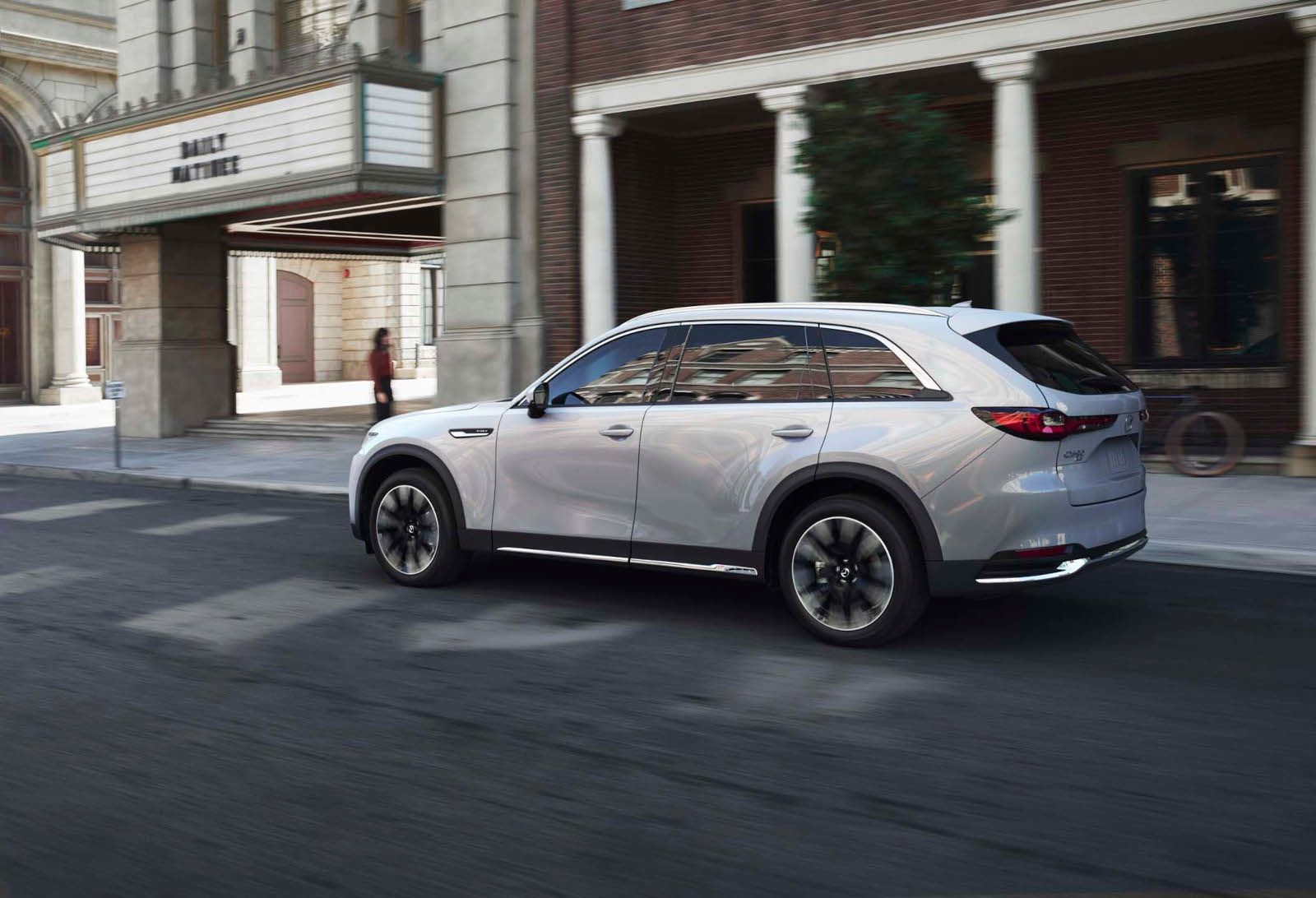
The commuting experience is consistent across all four CX-90 PHEV trims — the 43 km EV range, 17.8 kWh battery, Level 1/Level 2 charging compatibility, and Mi-Drive modes all carry through from GS to Signature. The differences between trims are comfort, technology, and safety features rather than powertrain or range.
Key additions at higher trims that improve the commute experience:
- GS-L — Cruise and Traffic Support for stop-and-go highway traffic; wireless Apple CarPlay and Android Auto; 12.3-inch centre display with touch functionality
- GT — Nappa leather seating, Bose 12-speaker audio, 360° View Monitor and parking sensors, Trailer Hitch View, Bose audio, 1,500-watt cargo outlet
- Signature — Driver Personalization System with facial recognition; full i-Activsense suite including Smart Brake Support Front Crossing, Emergency Lane Keeping with Head-on Traffic Avoidance, Turn-Across Traffic, Secondary Collision Reduction
The Gas Bill: Where Savings Actually Come From
The savings calculation for a PHEV is straightforward for regular commuters:
- Every kilometre driven in EV Mode on electricity rather than gasoline has a direct cost
- Alberta's average electricity cost per kWh, combined with the CX-90 PHEV's battery size and range, means each full electric charge costs a fraction of what an equivalent gasoline-only trip costs
- The blended NRCan rating of 4.2 Le/100 km reflects that mixed-driving reality — it's not a theoretical figure, it's based on the standard test cycle
For drivers who use the vehicle primarily for commuting and charge regularly, the annual fuel cost advantage compounds meaningfully over time. For drivers who travel long distances on weekends and commute on weekdays, the PHEV splits the fuel bill — electric for the predictable weekday routine, gasoline for the open-road trips where a tank of gas goes a long way.
CX-90 PHEV Commuter Reference
|
Feature |
Detail |
|---|---|
|
EV range |
43 km (NRCan) |
|
Battery |
17.8 kWh |
|
System power |
323 hp, 369 lb-ft |
|
NRCan blended |
4.2 Le/100 km |
|
NRCan highway (gas) |
8.5 L/100 km |
|
Level 1 charge (20–80%) |
6.4 hours |
|
Level 2 charge (20–80%) |
1.3 hours |
|
Mi-Drive modes |
Normal, Sport, Off-Road, EV + Charge Mode |
|
AWD |
Standard |
Talk to the Team at Sunridge Mazda
The 2026 CX-90 PHEV suits drivers with a predictable daily commute and regular charging access. To explore the PHEV lineup and go through the trims with the team, stop in at Sunridge Mazda in Calgary.